 Employee Portal
Custom Architectural Woodwork & Specialty Finishes
Custom Architectural Woodwork & Specialty Finishes



A Millworker’s Perspective
What happens when the material schedule does not match the specifications or when a selected finish creates problems with cost, availability, or fabrication?
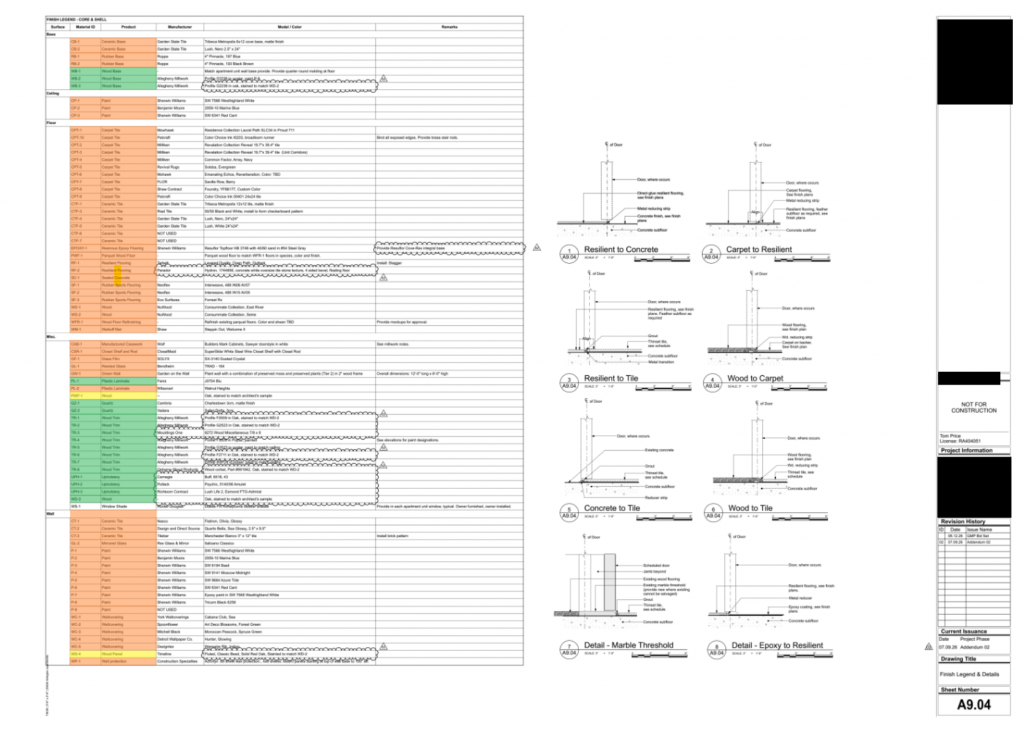
Before looking at those challenges, it helps to define the purpose of a material schedule. In commercial construction documents, a material schedule is typically presented as a table that identifies the specified finish materials for each room, space, or building surface. It may include the manufacturer, color, pattern, sheen, product number, and intended location.
When the material schedule is complete and coordinated with the specifications, it provides clear direction for everyone involved. When information is missing, conflicting, or impractical, however, it can create uncertainty during bidding and lead to delays during submittals, fabrication, and installation.
Long-Lead-Time Materials
Long lead times can delay a project or require material substitutions that involve the owner, architect, general contractor, and subcontractors.
The best time to identify a long-lead-time material is during the bidding process. The worst time is after it has already affected the project schedule.
Addressing availability early gives the project team time to evaluate alternatives, revise selections, or adjust the schedule before the material becomes a critical issue. A difficult conversation during bidding is much better than an emergency during submittals or fabrication.

Conflicts Between the Schedule and Specifications
Conflicts between the specifications and material schedule can create confusion when pricing, purchasing, fabricating, and installing the work.
For example, a standard laminate identified as PL-01 may be scheduled for corridor casework, while the specifications require all corridor millwork to meet a particular fire-performance requirement. The scheduled finish may not be compatible with the specified construction.
The best way to address this type of conflict is through a Request for Information, or RFI, during the bidding phase. Early clarification allows all bidders to price the same requirement and reduces the risk of costly changes after award.

Materials Listed as “TBD”
Materials identified as “TBD” should ideally be selected before the project is awarded. When they are not, the millwork contractor should submit an RFI and clearly explain that a delayed selection could affect procurement, submittals, or the project schedule.
If the material remains undetermined at bid time, an assumption may be necessary. That assumption should be clearly stated in the proposal, including the specific product, manufacturer, or allowance that was included in the price.
If the project is awarded while selections are still unresolved, the project manager should be notified immediately, and the outstanding RFI should remain a priority until a final decision is received.
Materials That May Not Suit the Application
There are also situations in which a specified material may not be practical for the intended design or application.
One example may be a quartz product specified for a highly formed or curved application. Depending on the product and fabrication method, attempting to create the required shape could affect the material’s appearance, durability, fabrication feasibility, or manufacturer warranty.
Rather than simply pricing an impractical detail, the millwork contractor should submit an RFI explaining the concern and recommending alternatives. Depending on the design intent, those alternatives could include solid surface or another finish that can achieve a similar appearance more reliably.
Providing samples and alternative options can help the design team preserve its vision while improving constructability.

How Giffin Interior Reviews Material Schedules
At Giffin Interior, reviewing the material schedule is one of the first steps we take when bidding a commercial construction project.
Each material is evaluated to determine whether it is included in our scope of work. Materials that are clearly part of our scope are identified accordingly. Materials that belong to another trade are also noted. When the responsibility is unclear, we ask the question through an RFI rather than making an unsupported assumption.
We also verify material availability and identify long-lead-time products during the bidding process. This gives our customers, the owner, and the architect an opportunity to consider alternatives before the project schedule is affected.
When the material schedule conflicts with the specifications, we request clarification. If clarification is not received before the bid is due, we clearly state our pricing assumption in the proposal.
When a material is listed as “TBD,” we ask for a final selection. If one is not provided, we document exactly what material or allowance has been included in our price.
When a specified material may not be the best choice for the application, we ask questions, explain the concern, offer alternatives, and provide samples when appropriate.
At Giffin Interior, we start planning the project before it becomes our project. By identifying material concerns early, communicating clearly, and offering practical solutions, we help protect the design intent, the budget, and the project schedule. Contact us to discuss your next commercial construction project.

